
Once you have established some training consistency (which is the first hurdle to overcome), the next question you should be asking, is how many times per week should I lift weights to see progress and results.
To best answer this question we must look at the supercompensation curve.
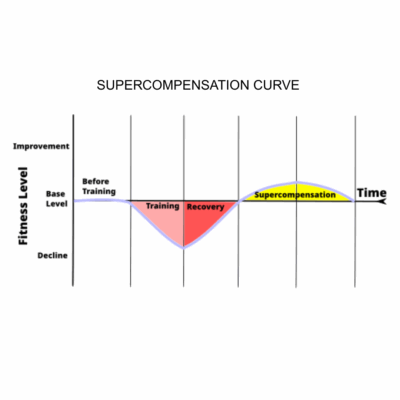
The supercompensation curve explains how the body responds to the stress of exercise. In layman’s terms, let’s say that you have a weight training session on Monday, the session will create trauma and fatigue within the muscle tissue and with this a decrease in performance. Post session, your body instantly starts the recovery process. By Tuesday your body has recovered to pre exercise levels and then on Wednesday your body overcompensates so that it can better handle the stress next time you repeat the weight training session (supercompensation).
Using this model, the number of times you weight train per week (training frequency) will create 1 of 3 outcomes.
PROGRESS
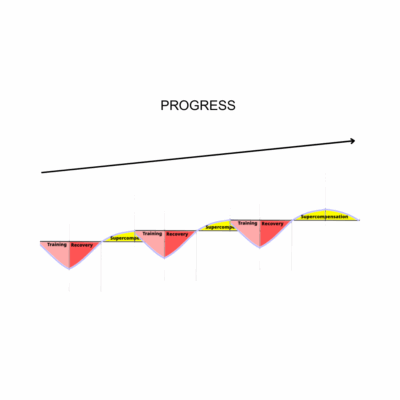
The optimal way to train is to hit the next session at the peak of the super compensation curve, therefore creating an undulating progressive curve.
OVER-TRAINING
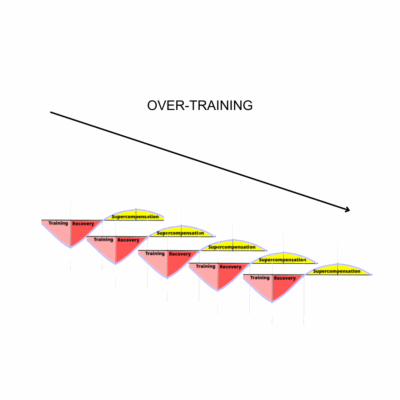
Train too frequently and your body will be in a constant state of repair, eventually leading to over training and decrease in performance.
THE ROAD TO NOWHERE

Leave too much time between training sessions and it will be hard to see any sort of tangible progress.
The trick here, is to figure out the length of time needed to recover between sessions. There are several factors that influence recovery, I have outlined some of the main ones below along with recommendations on training frequency.
NEW TO WEIGHT TRAINING / LOW EXPERIENCE.
If you are new to weight training or have a small amount of training experience then your recovery will take longer. Don’t stress, it will speed up as the weeks go on.
Our tip – So that you aren’t crocked for a week after your first session, use the following principles:
- start with lighter weights and/or bodyweight depending on the exercise and gradually increase over a number of weeks.
- Start low volume and gradually increase (e.g week 1 – 2×10, week 2 – 3×10, week 3 – 4×10. Or week 1 – 3×8, week 2 – 3×10, week 3 – 3×12)
EXERCISE SELECTION
Some exercises create more soreness (DOMS) than others and therefore take longer to recover from. Exercises with a dominant eccentric contraction (muscle contacting and lengthening) taken close to end range of motion, will produce a large amount of muscle soreness post workout. Below is a short list of big soreness producing exercises:
Lower:
- Romanian deadlifts
- Walking lunges
- Squats
- Bulgarian split squats
Upper
- Pec flys
- Pull overs
Don’t avoid these exercises. Exercises with a lengthened eccentric contraction are great for increasing muscle mass.
Our tip – It is all in the dose. If you are new to weight training then programme a maximum of 1 of these exercises for upper and lower per session. As you gain experience you will be able to tolerate more of these exercises per session.
YOUR SEX
Research suggests that women generally recovery faster than men between weight training sessions. Women tend to have higher levels of oestrogen, which have a protective effect on muscles, limiting muscle damage and accelerating repair. Women also have a higher proportion of slow twitch muscle fibres which fatigue at a slower rate and recover quicker than fast twitch fibres.
Our tip – Through our coaching experience we notice that women can generally handle greater training volume compared to men. Ladies, don’t be afraid to go for an extra set.
DEHYDRATION
Dehydration can impair muscle function, making them more susceptible to damage during exercise.
Dehydration reduces blood volume which can decrease blood flow to muscles. This can hinder the delivery of nutrients and oxygen needed for muscle repair and recovery.
Basically dehydration will worsen delayed onset muscle soreness (DOMS).
Our tip: stay hydrated, for every 25kg of body weight aim to drink 750ml-1000ml of water.
YOUR BIOLOGICAL AGE
Recovery generally slows down as we age due to a decline in muscle mass, reduced hormone levels and a slower cellular repair process.
Our tip – follow the points outline above and when needed take an extra day to recover
SO HOW MANY SESSIONS PER WEEK?
2-4 weight training sessions per week depending on the individual.
If you are new to weight training or returning after a break then start at the lower end of this range. As you gain experience then look to increase the number of sessions per week and you’ll start seeing real progress. If time permits then shoot for 4 sessions per week. Personally, I think 3x per week is the sweet spot and easier to balance with all other life commitments.
Book a free consultation
Leave your details and we’ll get in touch to arrange a consultation to discuss your goals.


