Think you need to burn more calories to get better results? Think again.
When it comes to changing your body, improving your fitness or managing your weight, it’s easy to focus on the calories you burn during a workout. But your body is doing far more than that. Every minute of every day, you’re using energy, whether you’re training at the gym, walking to work, sitting at your desk, sleeping or even digesting your lunch.
Understanding Total Daily Energy Expenditure (TDEE) gives you a much better picture of what’s actually happening. And once you understand it, you can start making smarter decisions about your training, nutrition and lifestyle.
So, where does all that energy go?
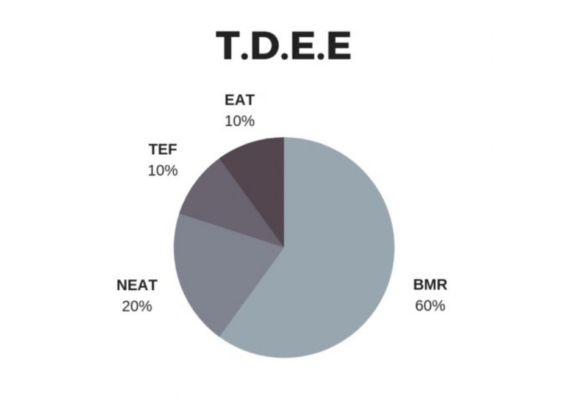
Your daily energy expenditure is made up of four different compartments:
1. Your metabolism
Your body needs energy simply to keep you alive.
Your heart is beating, your lungs are working, your brain is functioning and your organs are doing their jobs — even while you’re asleep. This is known as your Basal Metabolic Rate (BMR) and it makes up a large proportion of the energy you use every day.
In other words, you’re burning energy even when you’re doing absolutely nothing.
2. Your training
This is probably the part you’re most familiar with. Running, lifting weights, cycling, swimming, classes and other forms of exercise all require energy. But here’s the important bit:
Your workout is only one part of the equation.
You don’t need to spend hours in the gym trying to “burn off” what you’ve eaten. Good training should be about becoming stronger, fitter and more capable, not simply chasing a calorie number on a screen.
3. All the movement you don’t consider exercise
Here’s something many people overlook.
Walking around the office. Taking the stairs. Doing the housework. Shopping. Gardening. Standing up. Moving around while you’re on the phone. All of this uses energy.
It’s known as NEAT – Non-Exercise Activity Thermogenesis.
And depending on your lifestyle, these everyday movements can make a significant difference to how much energy you use across the day.
This is why two people can do exactly the same workout but still have very different daily energy expenditures.
4. Eating uses energy too
Yes — your body actually uses energy to process the food you eat.
Digesting, absorbing and processing nutrients all require energy. This is known as the Thermic Effect of Food.
Protein generally requires more energy to process than carbohydrates or fat, which is one of the reasons protein can be an important part of a well-balanced diet — particularly if you’re training and looking to build or maintain muscle.
When fat loss or weight loss is the goal, one of the first things people often do is increase their exercise, more gym sessions, longer workouts and more cardio.
But there’s a bigger picture.
As the chart shows, structured exercise is actually one of the smaller components of your total daily energy expenditure. So rather than relying on exercise alone to burn more calories, there’s another area you can have a much bigger impact on: your daily movement.
Increasing your daily step count and general activity (NEAT) is a simple and effective way to increase the amount of energy you use throughout the day.
Then, use your structured training for what it does best:
Get stronger. Get fitter. Build muscle. Move better.
Your metabolism isn’t a fixed number
This is where things get interesting.
Your daily energy expenditure isn’t set in stone. It can change as your body and lifestyle change.
Train more? You may use more energy.
Move less? You may use less.
Gain muscle? Your energy requirements increase.
Lose weight? Your body may require fewer calories to maintain its new body weight.
Your body is constantly adapting to what you do.
That’s why simply plugging your details into an online calorie calculator and treating the number it gives you as fact isn’t always helpful.
It’s a starting point — not a prescription.
So, what does this mean for you?
If your goal is to lose body fat, build muscle, improve your fitness or simply feel better in yourself, you don’t need to become obsessed with calorie counting.
Instead, look at the bigger picture.
Ask yourself:
Am I training consistently?
Am I moving enough throughout the day?
Am I eating enough of the right foods to support my goals?
Am I getting enough sleep and recovery?
Can I maintain these habits for the long term?
Because ultimately, results don’t come from one perfect workout or one “perfect” day of eating.
They come from what you do consistently.
Stop chasing calories. Start understanding your body.
At PROATHLON, we don’t believe training should be about punishment or constantly trying to burn more calories.
We believe in smart training, good nutrition, accountability and creating habits that actually fit around your life.
Because your goal isn’t simply to burn more energy. It’s to become stronger, fitter, healthier and more confident in what your body can do.
And that’s where the right support can make a real difference.
Ready to train with purpose?
If you’re tired of jumping from one workout plan to another, unsure what to eat or wondering whether you’re actually making progress, let’s change that.
At PROATHLON, our small-group personal training combines expert coaching, structured training and accountability to help you make sustainable progress — without having to figure it all out yourself.
Your body is capable of more. Let’s find out what.
Get in touch with PROATHLON today and let’s start your journey.
Book a free consultation
Leave your details and we’ll get in touch to arrange a consultation to discuss your goals.


